

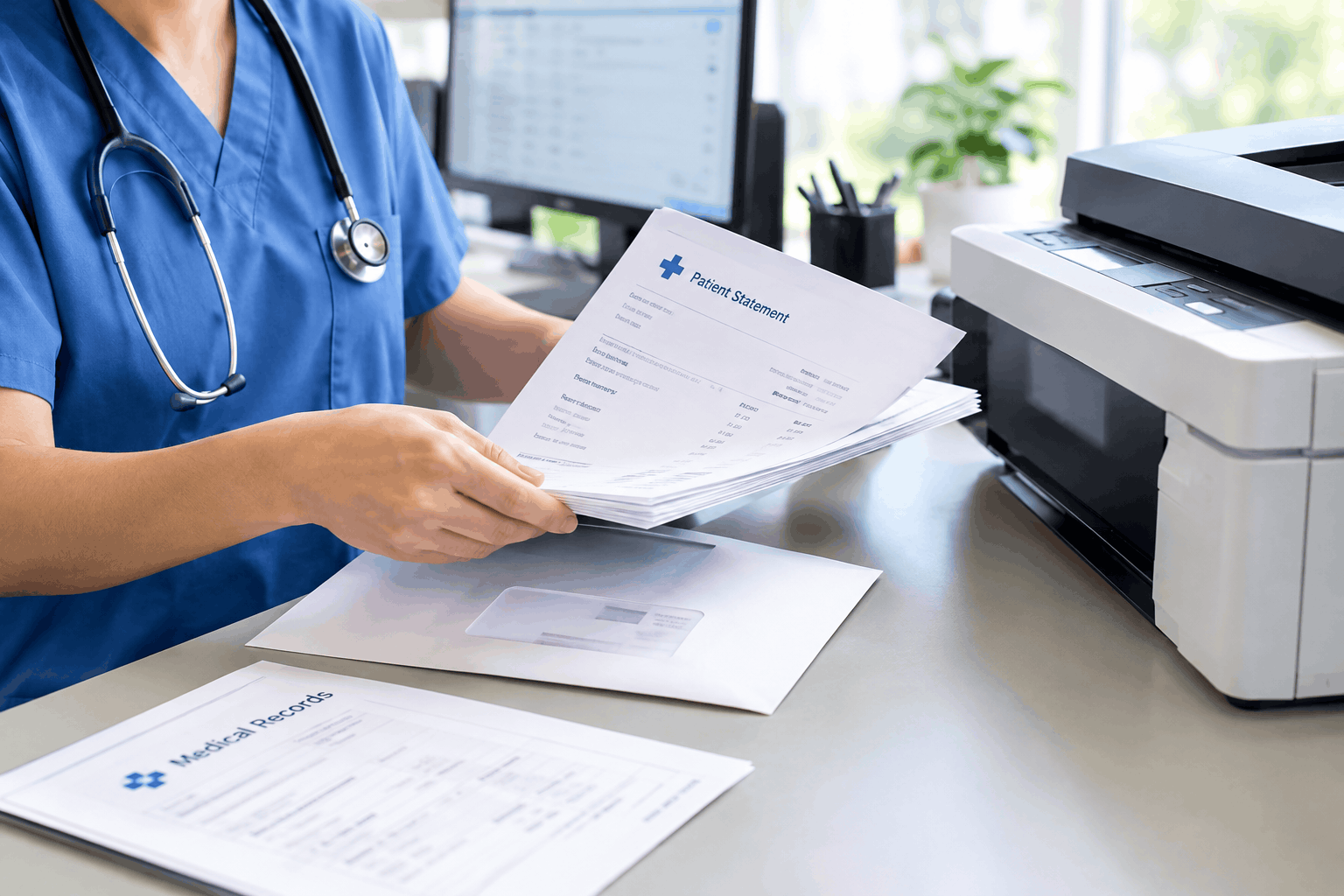

Healthcare providers handle a large amount of private information every day. From patient bills and medical reports to insurance statements and appointment letters, these documents often contain details that must remain confidential. Protecting this information is important for patient trust, legal compliance, and the smooth operation of hospitals, clinics, and medical offices. Even a small mistake in printing, handling, or mailing a document can expose sensitive information to the wrong person.
- Why Is Patient Document Security Important?
- What Types of Healthcare Documents Need Protection?
- How Can Healthcare Providers Protect Patient Information?
- What Does HIPAA Compliance Mean for Healthcare Documents?
- Why Is Secure Printing Important in Healthcare?
- How Can Healthcare Organizations Prevent Mailing Errors?
- What Are the Benefits of Outsourcing Healthcare Printing and Mailing?
- How Can High-Volume Printing Improve Operational Efficiency?
- Can Digital Patient Communications Reduce Paperwork?
- How Should Healthcare Providers Choose a Printing and Mailing Partner?
- What Role Does Employee Training Play in Document Security?
- How Can Healthcare Organizations Respond to a Document Security Incident?
- What Steps Can Small Clinics Take to Improve Document Safety?
- Conclusion
Healthcare organizations can reduce these risks by using secure document systems, training employees, checking mailing details, and choosing reliable printing and mailing partners. They also need clear procedures for managing both paper records and digital files. Understanding these steps helps medical teams protect patient privacy while keeping their daily work organized and efficient.
Why Is Patient Document Security Important?
Patient documents contain information that people do not want to share with strangers. These records may include names, home addresses, dates of birth, insurance details, account numbers, medical conditions, and treatment information. When this data reaches the wrong person, it can create serious problems for patients and healthcare organizations.
For example, a billing statement sent to an incorrect address may reveal details about a patient’s medical visit. An employee who leaves printed reports on an open desk may allow visitors to see private information. Similarly, sending an email attachment to the wrong recipient can expose sensitive records without anyone noticing immediately.
Document security helps prevent these situations. It also supports a professional relationship between healthcare providers and their patients. People are more likely to trust a medical organization when they know their personal information is handled carefully.
Security is not only about preventing hackers from accessing computer systems. It also involves everyday activities, such as printing reports, placing documents into envelopes, storing files, and delivering mail. Every step needs attention because information can be exposed through simple human errors as well as technical problems.
Healthcare organizations should therefore treat document protection as a regular part of their operations rather than a task that only the IT department handles.
What Types of Healthcare Documents Need Protection?
Many different documents contain private patient information. Some are created during medical treatment, while others support billing, insurance, communication, and administrative work.
Patient billing statements are a common example. These documents may include service descriptions, payment amounts, account details, and information about outstanding balances. If a statement is delivered to the wrong address, the patient may face privacy concerns and billing confusion.
Insurance documents also require careful handling. Explanation of Benefits statements, coverage notices, claim letters, and policy updates can contain personal and financial information. These documents help patients understand how their insurance works, but they must reach the correct recipient.
Appointment reminders and follow-up letters may reveal the name of a healthcare provider, a scheduled visit, or other sensitive details. Even a short message can disclose information that a patient prefers to keep private.
Hospitals and clinics also produce laboratory notices, referral letters, medical invoices, privacy notices, and patient rights documents. Health insurance companies may send large volumes of member communications throughout the year.
Each document type has different requirements, but the basic goal remains the same: information should be available to authorized people and protected from unauthorized access. Healthcare organizations should identify which documents contain sensitive data and create suitable procedures for handling each category.
How Can Healthcare Providers Protect Patient Information?
The first step is to create clear rules for handling patient information. Employees should understand which documents are confidential, who can access them, and how they should be stored, printed, shared, and destroyed.
Access should be limited to people who need the information for their jobs. For example, a billing employee may need access to payment records, while another staff member may only need appointment information. Giving every employee access to every record increases the chance of accidental exposure.
Strong passwords and multi-factor authentication can help protect digital systems. Healthcare organizations should also use secure file transfers and encryption when sending sensitive information electronically. These measures make it more difficult for unauthorized people to access data.
Paper documents need equal attention. Printed records should not remain unattended in shared spaces. Printers used for confidential work should be placed in controlled areas, and employees should collect documents promptly after printing.
Regular staff training is another important part of protection. Employees should learn how to identify suspicious emails, verify recipients, report mistakes, and handle confidential documents safely.
Healthcare organizations should review their security procedures regularly. A policy that worked several years ago may not address current technology, new communication methods, or changing business needs. Regular reviews help organizations find weaknesses before they lead to serious problems.
What Does HIPAA Compliance Mean for Healthcare Documents?
In the United States, the Health Insurance Portability and Accountability Act, commonly known as HIPAA, establishes important requirements for protecting certain health information. Its Privacy Rule and Security Rule address different aspects of safeguarding protected health information, including information held or transmitted electronically.
HIPAA applies to covered entities, such as many healthcare providers and health plans, as well as business associates when the relevant requirements apply. A business associate may provide services that involve handling protected health information on behalf of a covered organization.
Printing and mailing companies can fall into this category when their work involves protected health information for a healthcare client. In applicable situations, a business associate agreement helps define the responsibilities of both parties for protecting that information.
Compliance involves more than placing a privacy statement on a website or asking employees to keep documents confidential. Organizations need suitable administrative, physical, and technical safeguards based on the rules that apply to them.
Administrative safeguards may include employee training, risk assessments, written policies, and procedures for responding to incidents. Physical safeguards can involve controlled access to work areas, secure storage, and protection of printed records. Technical safeguards may include access controls, authentication, audit controls, and encryption where appropriate.
Healthcare organizations should not assume that using an outside provider automatically makes every process compliant. They need to evaluate the provider’s practices, agreements, and security controls. The exact requirements depend on the organization’s role and the information involved.
A well-managed compliance program reduces avoidable risks and helps employees understand their responsibilities when handling patient information.
Why Is Secure Printing Important in Healthcare?
Printing remains a necessary part of healthcare communication. Many organizations still send physical billing statements, insurance notices, appointment letters, and other documents to patients and members. These communications may need to reach people who do not use online portals or prefer receiving paper records.
However, printing creates several opportunities for mistakes. A document may be printed with incorrect information, left on a shared printer, mixed with another patient’s records, or placed in the wrong envelope. These errors can expose private information even when the computer system itself is secure.
Healthcare providers can reduce these risks by using controlled printing processes. Employees should verify document templates, check data sources, and make sure printing equipment is suitable for confidential work. Access to printed materials should be limited, and completed documents should be collected without unnecessary delays.
High-volume printing requires additional controls. When an organization produces thousands of statements in a single production run, manual checking alone may not be enough. Automated systems can help compare document information, detect missing pages, and confirm that the correct documents are grouped together.
Healthcare organizations that need outside support can consider specialized FSSI services for patient communications and confidential document handling. A suitable provider can help healthcare teams manage large print volumes while establishing consistent production and mailing procedures.
The important point is that secure printing must be planned from the beginning. Protecting a document at the computer stage is not enough if it becomes exposed during physical production or delivery.
How Can Healthcare Organizations Prevent Mailing Errors?
Mailing errors are a major concern when healthcare organizations send large numbers of documents. An incorrect address, a poorly matched envelope, or an outdated patient record can cause a private statement to reach the wrong household.
The first step is maintaining accurate address information. Healthcare teams should use approved procedures to update patient records when contact details change. Address verification tools and postal address correction services can help identify certain errors before mail enters the postal system.
The next step is document matching. Each printed statement must be placed in the correct envelope. Automated inserting equipment with suitable verification controls can help detect mismatched pages, missing documents, or incorrect sequences. The exact controls available depend on the equipment and production process.
Organizations should also establish clear quality checks. Sample inspections, automated alerts, production logs, and exception reports can help teams identify problems before documents are dispatched.
Returned mail requires attention as well. If a letter comes back because an address is incorrect, the organization should record the issue and follow an approved process for correcting the information. Repeatedly sending documents to an outdated address increases costs and may create privacy risks.
Finally, mailing teams should maintain appropriate records of production and dispatch. Tracking information can help organizations investigate delays, answer patient questions, and review possible errors.
These steps are especially important during busy periods, such as insurance enrollment, annual policy updates, and large billing cycles. A consistent process helps reduce avoidable mistakes and improves the reliability of patient communication.
What Are the Benefits of Outsourcing Healthcare Printing and Mailing?
Managing printing and mailing internally can require significant staff time, equipment, supplies, maintenance, and quality control. As an organization grows, these responsibilities may become more difficult to manage alongside patient care and administrative work.
Outsourcing can provide another way to handle these tasks. A specialized provider may have production equipment, document processing systems, trained employees, and established mailing procedures designed for high-volume work.
One potential benefit is improved operational efficiency. Instead of managing every printing and mailing task internally, healthcare staff can focus on activities related to patients, billing questions, insurance coordination, and other core responsibilities.
Another advantage is access to specialized equipment and processes. Depending on the provider, automated document production, envelope inserting, address processing, and quality checks may help reduce manual work and certain types of errors.
Outsourcing may also help organizations manage changing workloads. A hospital might need to send large numbers of statements at the end of a billing period, while an insurance company may have increased mailing needs during enrollment season. A provider with suitable capacity may help handle these changes without requiring the healthcare organization to purchase additional equipment.
Cost savings are possible, but they should not be assumed. Organizations should compare the full cost of internal production with the proposed outsourcing arrangement. This comparison should include labor, equipment, supplies, postage, security, service management, and any additional fees.
Privacy must remain a central consideration. Healthcare organizations should review the provider’s security practices, relevant agreements, staff access controls, incident response procedures, and ability to meet required service standards.
The best outsourcing arrangement is one that balances cost, reliability, security, and service quality.
How Can High-Volume Printing Improve Operational Efficiency?
Large healthcare organizations may send thousands or even millions of documents over time. Processing these communications manually can create delays, increase administrative work, and make quality control more difficult.
High-volume printing systems help organize production into repeatable steps. Data can be prepared, documents generated, print jobs scheduled, and completed pages checked through a defined workflow. Automation can reduce repetitive tasks and help employees manage larger workloads.
Document design also plays an important role. Clear headings, readable text, organized payment information, and simple instructions help patients understand what a statement means and what action they need to take.
For example, a well-designed billing statement can make the amount due, payment deadline, insurance adjustment, and payment options easy to find. This may reduce confusion and the number of calls received by billing departments.
Automation can also support consistency. Using approved templates and controlled data sources helps reduce formatting differences between documents. Production monitoring allows staff to identify unusual results, delays, or errors before the entire batch is completed.
However, speed should never replace accuracy. A fast printing process can still create serious problems if the wrong data is used or documents are matched incorrectly. Quality checks should remain part of every stage.
Healthcare organizations should measure performance through practical indicators such as processing time, error rates, returned mail, production costs, and patient inquiries. These measurements help managers identify areas for improvement.
When high-volume production combines automation with strong security and quality controls, healthcare teams can improve efficiency without treating patient privacy as an afterthought.
Can Digital Patient Communications Reduce Paperwork?
Digital communication offers another way to deliver healthcare information. Patient portals, electronic statements, secure messages, and online payment systems can reduce the need to print and mail certain documents.
For example, a patient may be able to view a billing statement through a secure portal instead of waiting for a paper copy. Email or text notifications can alert the patient that a new statement is available, provided the communication method follows applicable privacy and security requirements.
Digital options can reduce paper use, printing expenses, and postage costs. They may also help patients access information more quickly and make payments online.
However, digital communication is not suitable for every patient or every situation. Some people have limited internet access, prefer paper records, or need physical documents for their personal files. Certain communications may also have specific delivery or notice requirements.
Healthcare organizations should therefore consider a balanced approach. Patients can be offered appropriate digital options while physical mail remains available when needed or required.
Digital delivery also introduces its own security concerns. Organizations should avoid placing sensitive medical information in ordinary email or text messages unless the method is appropriate for the information and applicable requirements. Notifications can direct users to secure systems rather than exposing private details in the message itself.
Access controls, secure authentication, clear consent procedures where applicable, and reliable technical systems are important for digital communication.
A well-designed process can combine digital and paper delivery while keeping patient information protected and giving people practical ways to receive important documents.
How Should Healthcare Providers Choose a Printing and Mailing Partner?
Choosing an outside provider requires more than comparing prices. Healthcare organizations need to understand how the company handles confidential information, manages production, and responds to problems.
The first consideration is experience with healthcare communications. Providers should be able to explain how they manage patient statements, insurance letters, and other documents that may contain protected health information.
Security controls are equally important. Organizations should ask about employee access, facility security, data transfer methods, document verification, record retention, and incident reporting. They should also review relevant certifications or independent assessments and understand exactly what those credentials cover.
Where required, the healthcare organization should establish a suitable business associate agreement before the provider handles protected health information. Both parties should understand their responsibilities and how security incidents will be managed.
Production capacity is another factor. A provider should have the equipment, staffing, and workflow needed to meet expected volumes and deadlines. Healthcare organizations should ask how the company handles urgent jobs, unexpected increases in demand, equipment failures, and other disruptions.
Communication and reporting matter as well. Clear service expectations, regular performance reports, and a defined contact process make it easier to resolve problems.
Cost should be evaluated alongside quality. A low initial price may not represent the best value if the service has frequent errors, limited reporting, or unreliable delivery.
Before making a decision, healthcare providers should compare several suitable options and document their findings. A careful evaluation helps them choose a partner that supports both operational needs and patient privacy.
What Role Does Employee Training Play in Document Security?
Technology can prevent many problems, but employees still play a major role in protecting healthcare information. Even strong security systems cannot eliminate every risk caused by incorrect decisions or careless handling.
Training should explain how to recognize confidential information and follow the correct procedures for printing, storing, sharing, and disposing of documents. Employees should know when they are allowed to access patient records and what to do if they receive information they do not need.
Practical examples make training easier to understand. Staff members can learn how to verify a recipient before sending an email, collect documents from printers, secure paperwork during meetings, and check envelopes before mailing.
Employees should also understand how to report mistakes. If a document is sent to the wrong address or a confidential file is shared incorrectly, quick reporting may help the organization investigate and limit the potential impact. Staff should know whom to contact and what information to provide.
Training should not be limited to new employees. Regular refreshers help reinforce good habits and explain changes to policies, systems, and responsibilities.
Managers can support these efforts by making procedures easy to find and encouraging employees to raise concerns. When staff members understand why the rules matter, they are more likely to follow them consistently.
A strong security culture develops when everyone understands that protecting patient information is part of their job, regardless of their department or position.
How Can Healthcare Organizations Respond to a Document Security Incident?
Even organizations with strong procedures may experience a security incident. A letter may be delivered to the wrong address, a printer may produce an incorrect batch, or an employee may accidentally share a confidential file.
The response should begin with the organization’s established incident procedures. Employees should report the issue promptly so the responsible team can investigate what happened and determine which information may have been exposed.
The organization should take reasonable steps to contain the problem. Depending on the situation, this might involve stopping a mailing batch, restricting access to a file, correcting a production error, or contacting the relevant service provider.
Next, the organization should document the incident. Records should include the nature of the problem, the information involved, the steps taken, and the findings of the investigation. This information can help identify the cause and prevent similar incidents.
Healthcare organizations should also assess whether notification or reporting requirements apply. Under HIPAA, breach assessment and notification duties depend on the facts and applicable rules. Organizations should consult their privacy or compliance professionals when necessary rather than assuming every incident follows the same process.
After the immediate problem has been addressed, the team should review why it occurred. Was the address information outdated? Did a quality check fail? Was an employee unsure about a procedure? Did the system lack an appropriate control?
The answers can guide improvements to training, technology, and workflow design.
A timely and organized response helps healthcare organizations manage incidents responsibly, reduce further exposure, and strengthen their document security practices.
What Steps Can Small Clinics Take to Improve Document Safety?
Small clinics may not have the same budget or staff resources as large hospital networks, but they can still take practical steps to protect patient information.
Start by identifying where confidential documents are created, stored, and shared. This includes reception areas, consultation rooms, billing desks, printers, computers, and mail preparation spaces. A simple review can reveal places where documents are left unattended or accessed by people who do not need them.
Create clear procedures for everyday tasks. Staff should know how to collect printed records, verify mailing addresses, store paperwork securely, and dispose of documents that are no longer needed. Confidential paperwork should not be placed in ordinary recycling bins without suitable safeguards.
Limit access to patient information according to job responsibilities. Use individual accounts rather than shared passwords where possible, and remove access when an employee no longer needs it.
Small clinics should also review their backup and recovery arrangements. Important digital records need suitable protection against accidental deletion, equipment failure, and other disruptions. Backups should be protected and tested so that they can be restored when needed.
For clinics that send large volumes of billing statements or insurance letters, outsourcing may be worth evaluating. A suitable provider can offer production capacity and established workflows that would be costly to maintain internally. The clinic must still assess the provider’s security practices and meet its own legal responsibilities.
Finally, review procedures regularly and encourage staff to report problems. Small improvements, applied consistently, can make a meaningful difference to patient privacy and daily operations.
Conclusion
Keeping patient documents secure requires attention at every stage, from collecting information and preparing files to printing, mailing, and delivering communications. Healthcare organizations need clear policies, trained employees, accurate patient records, suitable technology, and reliable quality checks to reduce the risk of mistakes.
HIPAA compliance is an important consideration for many US healthcare providers, but effective document security also depends on practical daily habits. Organizations should protect paper records, secure digital files, verify recipients, and respond quickly when problems occur.
High-volume printing and mailing can become easier to manage when healthcare teams use well-planned workflows and appropriate automation. For some organizations, working with a specialized provider may also improve production capacity and reduce administrative pressure, provided privacy and security requirements are carefully addressed.
Ultimately, patient privacy and operational efficiency should work together. By reviewing their processes and making thoughtful improvements, healthcare providers can communicate more reliably, manage documents responsibly, and maintain the trust that patients place in their care.