



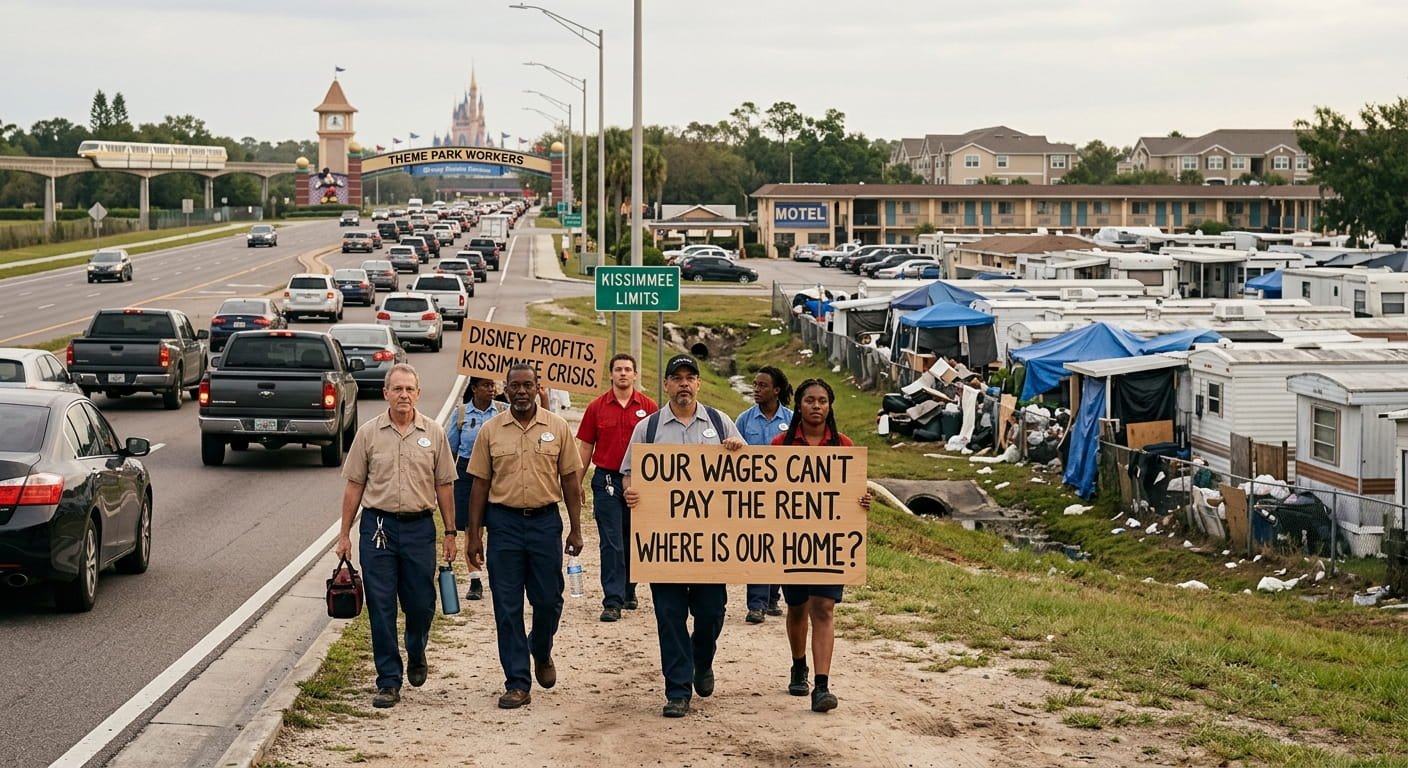

The average wage of a Disney World worker in Florida is around $37,000 to $41,000 full-time, while a median Kissimmee home costs $349,241. Nobody in the local government talks about this affordability gap and its consequences for the workforce.
Drive down US-192 through Kissimmee on any given morning, and you’ll see two very different worlds running side-by-side.
Motels with the weekly rate signs house hospitality workers who cannot afford a lease. Then, half a mile up, there’s a gated resort community with a “Vacation Rental Investment Opportunity” banner on a seven-bedroom pool home listed at $689,000.
Both are in Kissimmee, but both represent entirely different housing markets.
Kissimmee’s $349K Home Price Is Hiding Something Ugly
According to 2026 housing market data by Houzeo, Kissimmee’s median home price is up 1.5% year over year, and homes are sitting on the market for around 58 days. This reflects a balanced demand and not an explosive one. Still, this median price hides an uncomfortable reality underneath it.
The vacation rental corridor properties and the large pool homes near Disney’s gates are trading in an entirely different bracket. Five-bedroom homes in resort communities like Storey Lake and Windsor Hills routinely cost $600,000 and above. These aren’t primary residences. They are assets positioned to pull in $65,000 to $90,000 annually in vacation rental revenue.
The Kissimmee STR market has an average occupancy of 57%, edging over Florida’s state average of 54%. Larger properties generate up to $62,385 annually. There are currently 8,881 active Airbnb listings in Kissimmee.
That’s not a niche market. That’s a parallel housing economy operating inside the same zip codes where service workers are trying to find an affordable apartment.
The Paycheck That Doesn’t Reach The Front Door
The people making this tourism economy work, including the ride operators, hotel staff, food service workers, and entertainment crew, are not making luxury wages. ZipRecruiter data shows that the average annual pay for a Disney World worker in Florida is only $29,148, which is roughly $14 per hour. The majority fall between $22,400 and $32,900 a year.
In 2026, a buyer needs a realistic household income of around $70K. This is even before factoring in Florida’s unusually high property insurance costs, which push the real number still higher. That’s not the calculation these workers are dealing with.
Renting is hardly an escape route. As per the National Low Income Housing Coalition, a full-time worker needs to earn $37.27 an hour just to afford a two-bedroom rental unit at Florida’s Fair Market Rent without any cost burden. For someone making $14, that number doesn’t fit in the budget.
Kissimmee’s median household income sits at $53,758 in 2026. While that brings many households close to the income needed for home ownership, it still falls short. Neither does it offer a little financial cushion to renters facing these housing costs.
The city’s own 2040 Comprehensive Plan anticipates steady population growth through 2045, committing to provide sufficient space for residential development. This is to adequately meet the housing needs of the present and expected future population. Yet much of the new construction is not aimed at the local families. Developers are focused on what delivers the most returns. They’re building what sells fastest, i.e., vacation rentals and luxury properties.
New Construction That Wasn’t Built For You
In the Osceola News Gazette, a community advocacy leader was quoted bluntly, “Our new construction is almost entirely three products: large single-family homes, luxury apartments, or short-term rental properties that serve people who are only here on vacation.”
Across Florida, a minimum wage worker would need to work for 96 hours a week to afford a modest one-bedroom apartment. In the Orlando-Kissimmee area, where rents are higher than the state average, the situation is even more dire. The crowded motels are a visible reminder of that affordability gap.
Hope Partnership opened Thrive Studios (the former Crown Motel redevelopment) in April 2026, a project that aimed at converting weekly-rate motels into permanent housing.
There is no lack of home supply, with over 3,000 houses in Kissimmee for sale on platforms like Houzeo as of mid-July. The overall numbers show that most of this supply is for investment-grade and upper-tier housing.
However, workers with entry-level price points have few options and extremely high competition in the affordable range. Cash buyers have absorbed starter inventory and converted it into vacation rentals.
Disney Needs Workers, & They Can’t Afford To Stay
The economy here runs in a loop it can’t escape. Disney and Universal require workers to operate. Workers require housing. But the proximity to these parks keeps land values high, making affordable housing scarce for developers. Eventually, the workforce disperses farther, and commutes get longer. Kissimmee’s tourism boom has its own trade-offs as the housing situation worsens for the local workers.
Florida’s rental study from the University of Florida confirms the structural squeeze. Nearly 905,000 low-income renter households statewide, roughly one in three, are spending more than 30% of their income on housing. In Osceola County, that burden falls disproportionately on the service and hospitality workers who keep the region functional.
Investors paying near the park are rational actors. The numbers make financial sense to them. But collectively, their purchasing power has reshaped the housing supply in a way that leaves the community’s essential workforce with fewer options.
A Tourism Economy Eating Its Own Workforce
Kissimmee isn’t broken. The market data is stable, the inventory is reasonable, and prices haven’t crashed. For buyers with the right budget, it remains a functional and compelling market.
But two housing markets are running simultaneously in the same city. One is built on yield calculations and occupancy rates. The other is built on desperation and long commutes. The gap between them isn’t a blip or a temporary imbalance. It’s a structural feature that neither the market nor policymakers have found a way to address.
When the people who run the rides can’t afford to live near the rides, something’s gone wrong. And the numbers, for once, aren’t sugarcoating it.